Response to Week 3 readings on blogs
Knobel and Lankshear, in “Weblog Worlds,” raise some interesting questions for me. Working within the theoretical framework of New Literacy Studies, which sees the various literacies that people practice as being imbedded in specific social contexts, they examine instances of the current social practice of writing and reading weblogs, looking to see how “powerful writing” seems to be defined in the blogosphere. Power in the world of blogs is determined in part by having a lot of readers, but perhaps also by having a few readers (a circle of friends, or an affinity group with a common interest), who actively write back. They suggest that the writing that works in the blog world can be defined by an authentic purpose, a point of view, and the quality of presentation (including the idea that a blog should be easily accessible, and not require lengthy downloads of huge linked files), and they point to specific examples, such as the prize-winning blog, “little. yellow. different” [http://www.littleyellowdifferent.com/ ] written by a gay Asian-American, that have a real voice and stance. They argue that what they’ve found “calls into question” the usual composition definition of powerful writing, suggesting that what is typically taught as writing strategies (like the ones from my own comp book, Exploring Literacy) doesn’t capture these qualities—that powerful blogs typically command attention by breaking generic conventions, by hybridizing, rather than through such strategies as revision. And when the authors turn their attention to school blogs, to see if they can find evidence of powerful writing there—they don’t! Most school blogs are used for teacher postings of work and assignments or are performances of school tasks by students that could be done in any medium.
But when I look at the example of a class blog that I showed briefly in class, the one from Christian Pulver’s 101 class, at dcsurley@blogspot.com, I find lively writing on the parts of both teacher and students, even though the blog is obviously a class assignment and the students are responding to questions the teacher poses. But I think that both teacher and students are taking their discussion seriously—that this is an opportunity to extend the engagement of the class discussions, with a sense that other students are the real audience. Here’s one example from a student:
"I believe, that media is a “mirror” of society, because I the experience which non of you have, including the author of the introduction. I was born in a country( Soviet Union) where was no crimes, or murders on TV, but there were in reality, but no one was talking about them. One single example of Chernobyl catastrophe was cost many human life’s- media said nothing about it at that time on TV. Is this how exactly the author would like to broad cast the news- just don’t say anything , don’t panic, it could be worth……"
So school blogs don’t have to be empty and formula driven.
I’d also add that the blog itself is a new genre with its own conventions, and that those conventions can be explored openly by teacher and students through reading blogs and discussion them, and seeing why they might have arisen, and how one might gain attention of readers by altering them.
Course homepage
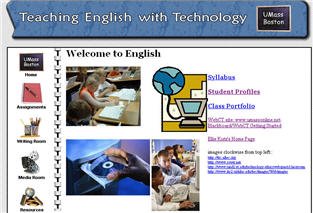
Course homepage
Showing posts with label Weblog Worlds. Show all posts
Showing posts with label Weblog Worlds. Show all posts
Thursday, 14 June 2007

Subscribe to:
Posts (Atom)