The SITWiki Commandments at Deakin University (Augar, et al) seems to address what would be one of my major concerns about using a Wiki. At one point during the past year my students were in the library doing some research on Huck Finn and one of my students thought it would be funny to edit Wikipedia to mention that another student had not showered that morning, so that under the heading of Twain's life, it said something along the lines of, “Bob did not take a shower this morning.” These commandments would see the students facing disciplinary measures if they had inappropriate postings. It says that “Offenders will be dealt with in accordance with Deakin's Internet Usage Guidelines” (Augar, et al). In class the other night, someone (I forget who, sorry!) brought the concern of anyone being able to edit or delete content, and having this disclaimer on every page might help to prevent that. The commandments themselves are also geared to preventing poor usage of the Wiki: “The first step was the development of a set of four clear usage guidelines. Powazek (2002), advises that usage guidelines should be short, simple and written in a positive tone” (Augar, et al). This lead to the following commandments:
“1. Post frequently, Post well, Post haste
2.Be nice
3.Wiki unto others as you would unto you (When posting on the wiki treat other online group members as you would like to be treated)
4.Remember that your contribution is critical to the success of the group”
Not only are these positive reminders, but they are also somewhat humorous and one would hope that students take them seriously and at least notice them because of that. These commandments helped to foster an active and supporting online community, and that is something that I would certainly be striving for if I were to use a wiki with my classes.
It would certainly be fun to have all 120 of my students accessing the same page; we could have some fun conversations linking all the texts together (this is happening in my imagination right now). Imagine sophomores and juniors having a discussion about justice that uses The Crucible from the sophomore curriculum and Macbeth from the junior one. I'm getting chills just thinking about it.
I do have on gripe with this article: Too many simple sentences, and not enough sentence variety.
Course homepage
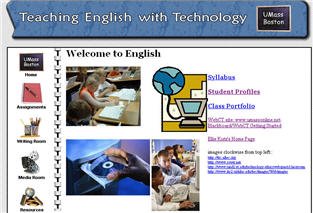
Course homepage
Thursday, 14 June 2007

"Weblog Worlds" and the problem of engaged writing
Response to Week 3 readings on blogs
Knobel and Lankshear, in “Weblog Worlds,” raise some interesting questions for me. Working within the theoretical framework of New Literacy Studies, which sees the various literacies that people practice as being imbedded in specific social contexts, they examine instances of the current social practice of writing and reading weblogs, looking to see how “powerful writing” seems to be defined in the blogosphere. Power in the world of blogs is determined in part by having a lot of readers, but perhaps also by having a few readers (a circle of friends, or an affinity group with a common interest), who actively write back. They suggest that the writing that works in the blog world can be defined by an authentic purpose, a point of view, and the quality of presentation (including the idea that a blog should be easily accessible, and not require lengthy downloads of huge linked files), and they point to specific examples, such as the prize-winning blog, “little. yellow. different” [http://www.littleyellowdifferent.com/ ] written by a gay Asian-American, that have a real voice and stance. They argue that what they’ve found “calls into question” the usual composition definition of powerful writing, suggesting that what is typically taught as writing strategies (like the ones from my own comp book, Exploring Literacy) doesn’t capture these qualities—that powerful blogs typically command attention by breaking generic conventions, by hybridizing, rather than through such strategies as revision. And when the authors turn their attention to school blogs, to see if they can find evidence of powerful writing there—they don’t! Most school blogs are used for teacher postings of work and assignments or are performances of school tasks by students that could be done in any medium.
But when I look at the example of a class blog that I showed briefly in class, the one from Christian Pulver’s 101 class, at dcsurley@blogspot.com, I find lively writing on the parts of both teacher and students, even though the blog is obviously a class assignment and the students are responding to questions the teacher poses. But I think that both teacher and students are taking their discussion seriously—that this is an opportunity to extend the engagement of the class discussions, with a sense that other students are the real audience. Here’s one example from a student:
"I believe, that media is a “mirror” of society, because I the experience which non of you have, including the author of the introduction. I was born in a country( Soviet Union) where was no crimes, or murders on TV, but there were in reality, but no one was talking about them. One single example of Chernobyl catastrophe was cost many human life’s- media said nothing about it at that time on TV. Is this how exactly the author would like to broad cast the news- just don’t say anything , don’t panic, it could be worth……"
So school blogs don’t have to be empty and formula driven.
I’d also add that the blog itself is a new genre with its own conventions, and that those conventions can be explored openly by teacher and students through reading blogs and discussion them, and seeing why they might have arisen, and how one might gain attention of readers by altering them.
Knobel and Lankshear, in “Weblog Worlds,” raise some interesting questions for me. Working within the theoretical framework of New Literacy Studies, which sees the various literacies that people practice as being imbedded in specific social contexts, they examine instances of the current social practice of writing and reading weblogs, looking to see how “powerful writing” seems to be defined in the blogosphere. Power in the world of blogs is determined in part by having a lot of readers, but perhaps also by having a few readers (a circle of friends, or an affinity group with a common interest), who actively write back. They suggest that the writing that works in the blog world can be defined by an authentic purpose, a point of view, and the quality of presentation (including the idea that a blog should be easily accessible, and not require lengthy downloads of huge linked files), and they point to specific examples, such as the prize-winning blog, “little. yellow. different” [http://www.littleyellowdifferent.com/ ] written by a gay Asian-American, that have a real voice and stance. They argue that what they’ve found “calls into question” the usual composition definition of powerful writing, suggesting that what is typically taught as writing strategies (like the ones from my own comp book, Exploring Literacy) doesn’t capture these qualities—that powerful blogs typically command attention by breaking generic conventions, by hybridizing, rather than through such strategies as revision. And when the authors turn their attention to school blogs, to see if they can find evidence of powerful writing there—they don’t! Most school blogs are used for teacher postings of work and assignments or are performances of school tasks by students that could be done in any medium.
But when I look at the example of a class blog that I showed briefly in class, the one from Christian Pulver’s 101 class, at dcsurley@blogspot.com, I find lively writing on the parts of both teacher and students, even though the blog is obviously a class assignment and the students are responding to questions the teacher poses. But I think that both teacher and students are taking their discussion seriously—that this is an opportunity to extend the engagement of the class discussions, with a sense that other students are the real audience. Here’s one example from a student:
"I believe, that media is a “mirror” of society, because I the experience which non of you have, including the author of the introduction. I was born in a country( Soviet Union) where was no crimes, or murders on TV, but there were in reality, but no one was talking about them. One single example of Chernobyl catastrophe was cost many human life’s- media said nothing about it at that time on TV. Is this how exactly the author would like to broad cast the news- just don’t say anything , don’t panic, it could be worth……"
So school blogs don’t have to be empty and formula driven.
I’d also add that the blog itself is a new genre with its own conventions, and that those conventions can be explored openly by teacher and students through reading blogs and discussion them, and seeing why they might have arisen, and how one might gain attention of readers by altering them.
Wednesday, 13 June 2007
Blogs----are they useful for discussions?
Week Three Discussion-- On Krause’s “When Blogging Goes Bad..”
The name of the article caught my eye because I’m having a hard time keeping up with technology so when I saw the “bad” in the title, I felt vindicated for all my feelings of inadequacy with computers. But the truth is, the more I read what Krause had to say about blogs, the more I understood their benefits and usefulness. Krause just had a problem using them with a particular classroom.
Krause gives multiple examples where blogs can play a major role in a writing classroom. One of the most important features a blog has is the ability to change the whole dynamic of a classroom. (p8) Krause explains how blogs encourage and transform student writing. Instead of having to write the same old, unexciting ,academic assignment for class, students create and write blogs knowing their work will be read by many instead of just the teacher. The expanded reader audience makes a huge difference in their writing, according to Krause. He uses words like authentic and unique to describe his students‘ writing.(p12)
Krause also quotes two educators, Delores Schriner and William Rice who also noticed a huge difference in students when they posted online, saying, “ they knew they had an audience beyond the teacher, and as a result their writing emerged as ’real, volunteered’ and even urgent.”(p8)
These writers all reinforce the argument for blogs citing more commitment, participation, purpose and effort in their student writers. I personally agree with their assessment because I definitely think twice and reread what I am writing before I post knowing everyone is going to be reading what I wrote. Whether it makes us more conscientious or more paranoid, using blogs and writing online makes writers more aware of what they are writing.
I can’t end this discussion without bringing up the “bad” that Krause touches upon. Although Krause reiterates how valuable and useful blogs can be, he also restates his belief that blogs are not “interactive and collaborative” (p.2) writing tools. He gives the example of having to “invite” users in order to write on blogs. I personally can attest to this downside. I wanted to get a jump start on the discussion and post it earlier than Thursday but was unable to use the Engltech697 blog, because I hadn't been invited yet. This is no reflection on Professor Kutz. I am just agreeing with Krause that there are limitations to interacting with blogs.
Krause argues blogs are not an effective discussion form and compares them to printed books and texts, saying “blogs have the distinct advantage of allowing individuals to easily publish texts that can be responded to by others to be sure, but those texts are not more ’collaborative’ than texts published in conventional print.” (p11)
So, keeping Krause in mind and his discontent with blogs being used effectively for discussion, I think this weeks posting will be a good test to see if we all can “interact” and “collaborate” using blogs.
The name of the article caught my eye because I’m having a hard time keeping up with technology so when I saw the “bad” in the title, I felt vindicated for all my feelings of inadequacy with computers. But the truth is, the more I read what Krause had to say about blogs, the more I understood their benefits and usefulness. Krause just had a problem using them with a particular classroom.
Krause gives multiple examples where blogs can play a major role in a writing classroom. One of the most important features a blog has is the ability to change the whole dynamic of a classroom. (p8) Krause explains how blogs encourage and transform student writing. Instead of having to write the same old, unexciting ,academic assignment for class, students create and write blogs knowing their work will be read by many instead of just the teacher. The expanded reader audience makes a huge difference in their writing, according to Krause. He uses words like authentic and unique to describe his students‘ writing.(p12)
Krause also quotes two educators, Delores Schriner and William Rice who also noticed a huge difference in students when they posted online, saying, “ they knew they had an audience beyond the teacher, and as a result their writing emerged as ’real, volunteered’ and even urgent.”(p8)
These writers all reinforce the argument for blogs citing more commitment, participation, purpose and effort in their student writers. I personally agree with their assessment because I definitely think twice and reread what I am writing before I post knowing everyone is going to be reading what I wrote. Whether it makes us more conscientious or more paranoid, using blogs and writing online makes writers more aware of what they are writing.
I can’t end this discussion without bringing up the “bad” that Krause touches upon. Although Krause reiterates how valuable and useful blogs can be, he also restates his belief that blogs are not “interactive and collaborative” (p.2) writing tools. He gives the example of having to “invite” users in order to write on blogs. I personally can attest to this downside. I wanted to get a jump start on the discussion and post it earlier than Thursday but was unable to use the Engltech697 blog, because I hadn't been invited yet. This is no reflection on Professor Kutz. I am just agreeing with Krause that there are limitations to interacting with blogs.
Krause argues blogs are not an effective discussion form and compares them to printed books and texts, saying “blogs have the distinct advantage of allowing individuals to easily publish texts that can be responded to by others to be sure, but those texts are not more ’collaborative’ than texts published in conventional print.” (p11)
So, keeping Krause in mind and his discontent with blogs being used effectively for discussion, I think this weeks posting will be a good test to see if we all can “interact” and “collaborate” using blogs.
Subscribe to:
Posts (Atom)